
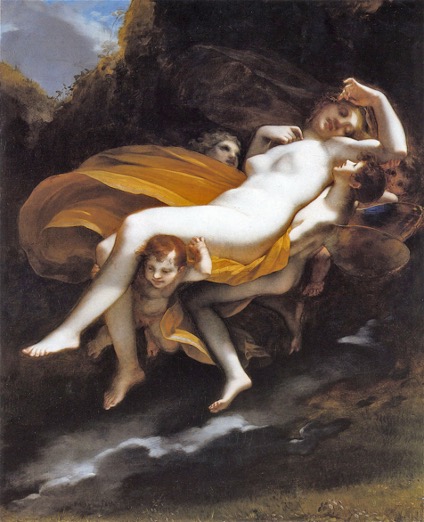
The Abduction of Psyche by Zephyrus to the Palace of Eros. Pierre-Paul Prudhon. Oil on canvas (1808).
It is impossible to do sex work for very long—or, to the point, to do sex work very well—without surrendering something which is considered by many to be a type of “innocence” lost. Conventionally, this ‘innocence’ is normatively evaluated as positive even though its loss, in fact, entails special access to a certain form of truth. It may be the case that in one sense, a normative taboo against the loss of ‘sexual innocence,’ a form of mandatory ignorance, is itself quite valuable, towards certain political or social ends. Nonetheless, it is also the case that the access to truth upon which this concept of “loss” is founded is actually both quite valuable, and quite real.
Perhaps not all have ears—or heart—to endure or appreciate this truth, to allow it to settle coherently among the other presumptions on sex and love which constitute a view of the world. For many, this type of realization entails significant upheaval and pain—for example, in the pure horror of the arbitrary. Only a few will both be capable of enduring that horror and also understanding its worth. In any case, behind that horror lies this truth: in order to expertly do sex work, and gain mastery of it as a skill, we must be prepared to categorically surrender the notion that romantic love is special, unique, or perhaps even uniquely valuable. In developing the refined, complex skill set necessary to excel in sex work, we do not always learn to cleave romantic love from sex. Instead, we learn to no longer conceive of romantic love as rare and exclusive, nor to see it as arising only between one single person and another, who are then bound together, inevitably, for all time.
In this sense, one might think that to support the decriminalization of sex work is intrinsically a socially liberal political position. But as a friend of mine who teaches at Harvard commented to me once, the nuclear family and its concomitant love-sex-monogamy formation is a fairly recent historical invention. It requires active support to uphold; its basis is a contingent ethical and philosophical justification; and yes, it is true that this basis is and ought to be subject to questioning and critique. For this we do well to talk with sex workers.
The reality is that love exists and does not exist, at times, between sex workers and their clients, and elsewhere, outside traditional relationships, diffuse throughout the world. It may be wholly present in an encounter, and then vanish forever. It may permeate an interaction and persist long after it ends; it may be simultaneously there, and not there, contemporaneously within the schism of a single occasion. These ideas are poorly understood, even if the populace pretends at adoring the archetypal ‘hooker with a heart of gold.’ Her ‘true love’ develops through a sex work transaction, which allows her to be absolved of the unenviable work. Thus, the myth that romantic love involves no real ‘labor’ is complete. In any of these cases—save the last, well-worn and well-loved, Julia Roberts, Pretty Woman—the outcome is that sex workers have a capacity to understand the contingent and accidental nature of love, which most other people find intuitively frightening, isolating, even cold. In fact, when a sex worker surrenders the ideal of a fateful love which could never be contingent, this is cited as proof of the corruption of her profession, her contemptible core.
The sex worker often may become a scapegoat (ע ָזא ֵזֽל) virtually in the literal religious Judaic sense. Just as the religious Jewish scapegoat was sent into the wilderness to expiate the sins of the community, the sex worker lives at the margins. Upon her, men unload all untold sins, inexpiable truths, real desires experienced as excess, emasculation, deviance—or simply too harsh to unleash upon any “Good Women”—
Men may even unload the sins of many such Good Women, which are relayed as a smoke signal to the whore through the conduit of Man. The overwhelming and invisible reality, of course, is that not all these desires or truths are sexual—perhaps even the majority are meaningfully nonsexual. They are affective, labile, unclear, existential, emotional, romantic, political, affective, philosophical, physical, psychological, and religious. They derive from blind pursuit of pleasure, from misogyny, loneliness, confusion, disability, terminal illness, unintelligence, isolation, or fear. From suppression, aggression, pain, homophobia, and yet insight, shame—and also reverence, hope, self-overcoming, and love.
Indeed, sometimes there exists an injunction that the very truest of loves must be exorcised from a man through his patronage of a whore. Throughout, there is one constant: Man casts his desire (which is a hidden Truth) negatively as sin; it is what the archetypal whore will absorb. She is then cast out into the wilderness, exiled—the just dessert of her receptivity—and thereby she symbolically redeems the whole decent horde of Humanity left behind. Lives rise and fall on this axis. It is wholly superstitious and irrational yet entirely real. This is no ancient lore; it is the everyday being of a whore. To us, and for us, however—us, the whores—it is different. Apart from the impact of stigma and criminalization—which of course is contrived and comes afterwards—we would in no way experience the pleasure or worth of our labor as being intrinsically corrupt. We witness the interior of sin, its hidden worth, and human face—not merely in profoundly psychic or normative terms. Not always as laudable ascesis—pragmatically, we gain an understanding which simply enables our material survival. Mastery entails a capacity for volleying the bestowal and deprivation of pleasure into forms of economic, social, sexual, psychological, and even political and religious control. We exercise power in this subterranean manner, but it is no less real for that. Some might argue it is all the more challenging to supersede as a result of its exercise being concealed, indirect, not overt. Theoretically, we gain access to rarefied and uncommon forms of wisdom in this process, which the laypeople are trained to revile because they are forbidden to know.
One primary forbidden truth is that love is so intrinsically human that no “true” love is ever even partially either fragile or irreplaceable. Love is not subject in the manner we presume to laws of an objective market or economic scarcity. It is a powerful force that can truly generate and regenerate itself between strangers, between clients and providers, in and through an entirely transactional encounter, in fleeting moments of anonymity. Transaction inexorably exists in “conventional” romantic relationships; inversely, in the transaction of sex work there often exists affection, intimacy, or even a rare ‘true love.’
One derivative truth is that love is sufficiently diffuse enough to let go. Genuine intimacy, which may appear at times to exist in only fleeting and transitory moments, is never truly so lost and irrecoverable as common understanding implies. Often the most precious forms of love will suffocate, if one attempts to prolong them, identify them, or subject them to any type of fearful approach. This goes against all we are taught about the manner in which monogamous love proves itself, through notions of possession, property ownership and jealousy. In particular, it goes against what women are taught as they age in an extrinsic mandate of unworthiness and fear—the false choice, between false propriety in rushed marriage, and false loneliness of well-earned solitude in age.
Due to a lack of understanding of these truths, laypeople cling violently to rigid and prescriptive ideals for relationships based on the nuclear family and couple form. These are sometimes viewed as practical arrangements. Indeed, they often are nothing more or less than that. Many traditional “marriages” entail much more exploitative and banal forms of “sex work” than the most meaningful encounters which a professional sex worker has. Laypeople, however, struggle to function in the face of such unfixity; thus, traditional marriage is mythologized, both as the most legitimate social currency of love, and as intrinsically more gratifying than any love available to a woman who is or has been a “whore.” Each of these are indeliberate lies.
Laypeople will understand consummate romantic love teleologically as at least one central component among those things which determine our identity and worth as human beings. Clearly love is an influential force in human life. But what is amusing is that historically, the unrivaled autonomy women access in sex work empowers them economically and politically in a way fundamentally inaccessible to the Wife. In turn, it is deeply ironic that such autonomy has granted the sex worker her own private, affective world—which, unlike so many marriages, is characterized by a free expression of her own desire, fully uncompromised by any economic coercion of the heart. This concealed truth, upon which the whore’s power is based, is that the individual is far more independent from the couple form per se. Simultaneously, the same truth entails that all of us are far more interdependent within the community of humanity than we know.
For most, adulthood entails the gradual attenuation of friendship in favor of an emphasis on the exclusive claims to legitimacy exercised by the affective and sexual bonds of romantic love. The self and the “significant other” are bound together, for all time. The unlucky, who of course are also the majority, find themselves corralled into “romances” which are fundamentally incompatible with the free expression of their sexual or emotional lives. Far from a Disney ending, this is nonetheless widely simultaneously seen as normal, expected, and unchangeable. It is even deemed inappropriate to seek an outlet in one’s friends or greater community beyond this, even when such outlets might make a primary partnership more gratifying and more sustainable.
This is a great mistake of humankind; it is one which sex workers witness from the margins with humor and tragic insight. We know the secret of your unhappiness; you proclaim to us that our own secret self-knowing is, itself, a thing which has its origin in a curse. Again, and again, you cast us out into the wilderness; you are welcome to continue; the truth will persist. As long as truth persists, the whore will survive.
The ‘human’ is an embodied and embedded being, existing as the intersection point for a given rhizomatic network of forces constituting their social world. Not coupled like songbirds in divinely ordained ordered pairs, we are not bound to the number “two” by any physical or mathematical law. The will emerges from and returns to its Dionysian drove. The couple form is Apollonian, a shield us from the uncoupling of the drove. Yet if we let ourselves fall, amidst such flux and infixity, we will find we are actually safe in the haven of the swarm. Often, we are far safer there, than nestled and isolated into an Atomic Pair. “A free life is still free for great souls,” said Nietzsche. Rare possible formations of friendship incubate in this instability and on its condition, romantic or otherwise, both or neither. Just as Foucault described historical instances of lesbian love: here exist “dense, bright, marvelous loves and affections” which all grow “very dark” very “sad,” in turn.
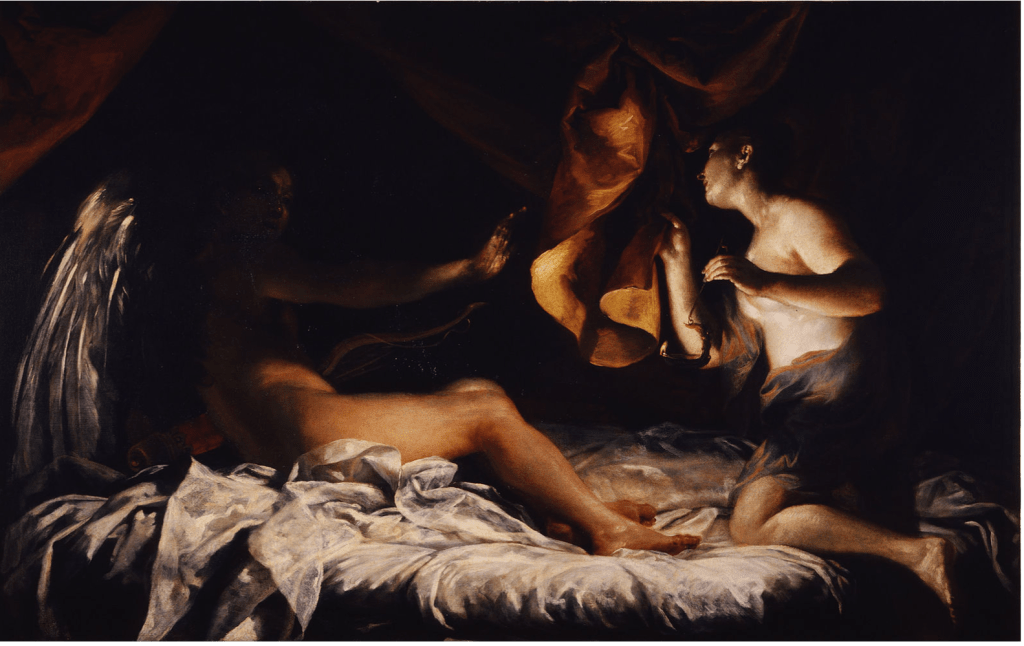
Amor e Psyche, Giuseppe Maria Crespi. Oil on canvas (1709).

What is ultimately most compelling is the activity of such loves. Their very being asserts itself actively in relation to the institutions of dominant powers and mores. In contrast, the passivity of any relationship derived negatively, from grand old archetypes, proscribed through withering institutions and ruins—is easily eclipsed by inalienable joy. It is accessible perhaps, too, to the “lonesome” and occasional, noble “twosome,”* but it is a thing no one can credibly assert dwells anywhere in “the couple form.”
Thank you for reading!
Princess Giulia
*This notion of the “lonesome and the twosome” is from the following excerpt from a passage on the State called ‘The New Idol,’ in Friedrich Nietzsche’s Thus Spake Zarathustra:
The earth is free even now for great souls. There are yet many empty seats for the lonesome and the twosome, wafted by the aroma of still seas.
A free life is even now free for great souls. Truly, whoever possesses little is that much less possessed: praised be a little poverty!
Only where the state ends, there begins the human being who is not superfluous: there begins the song of necessity, the unique and inimitable tune.
Where the state ends—look there, my brothers! Do you not see it, the rainbow and the bridges of the Ubermensch?—
Thus spoke Zarathustra.
 Princess Giulia Ricci