

A WOMAN IN ANCIENT ATHENS COULD WALK THREE PATHS.
First, a woman could be a wife (γυνή). The wife spent her life tending to child and household for her husband. An Athenian man proved his character through his skill in enslaving his wife. Even if she was favored, her value to him lay in her existence as his slave.
Second, pornai (πόρναι). The term pornai gives us the word pornography in English.The fate of these women was to be a sexual toilet. A pornai was legal property of her pimp (πορνοβοσκός), and spent life enslaved to the ugliest sexual urge of men.
Third, a woman might be a hetaera (ἑταίρα).
Between these three paths—only hetaerae were free.

Hetaerae were gilt-edged courtesans who inveigled, educated and enchanted elite men. A hetaera sustained herself through affiliations—with the most powerful businessmen, military leaders, philosophers, and political magnates of her time.
Hetaerae were luminaries. No women living were more highly educated, benignantly networked or political. Hetaerae were not muses—but virtuosos. To be one meant rapturous beauty, magnetizing personality, knife-like wit. With peerless facility in the arts these fine-spun Hellenistic women joined spirited public debates, used their wealth to influence politics, entranced the great men of Athens who offered their philanthropic patronage in return. Hetaerae therefore exerted an immense, unseen influence over the Hellenic world. They were the only women in Western antiquity who voted, were literate, acted nobly in the polis—who cultivated virtue.
We may use Aristotelian reasoning to demonstrate the truth about the hetaera and her freedom. The great philosopher Aristotle said that the human being is “by nature a political animal.” He asserts in 1.1253a of Politics: “the man that is by nature and not merely by fortune citiless is either low in the scale of humanity or above it. . .” Recall how the wife was elevated “above the scale of humanity,” and pure in her service to the home. The pornai was degraded as base, lowly and beneath the highest potential of the human being. In contrast, hetaerae acted, thought, created, destroyed—flourished as women among men. At the strife and spring of Western civilization, only this small coterie of women courtesans met the Aristotelian definition of a “human being.”
A woman who is a human being—does she exist today?

My name is Princess Giulia Ricci. You may call me Giulia, or Princess Giulia. “Giulia” is simply the Italian spelling of “Julia,” and so it is pronounced the same.
My IQ is 152. My breasts are DD. I am a 29-year old, blonde, brown-eyed student getting an advanced degree in Continental European Ethical and Political Philosophy. I am a dancer, memoirist, fine art oil painter, thinker, lover, and filmmaker. I first attended college at an extremely young age, and have been assured access to a world-class education for my entire life.
I love working as a Domme.
I know ecstasy. My heart is hot-blooded and glowing even as my mind is mercilessly analytical. I love unending, nomadic dialogues about philosophy, talks which dare to push uncomfortable boundaries in rethinking power, desire, heart. In power exchange, I am pursuing new terrains of pleasure, new perspectives, new challenges, new weapons, new reasons for war. I hunt new forms of friendship, a new politic, new love. I want pansophy in such encounters, and I will never undervalue the gentlemen who discover me. I battle to become a noble actor in this world.
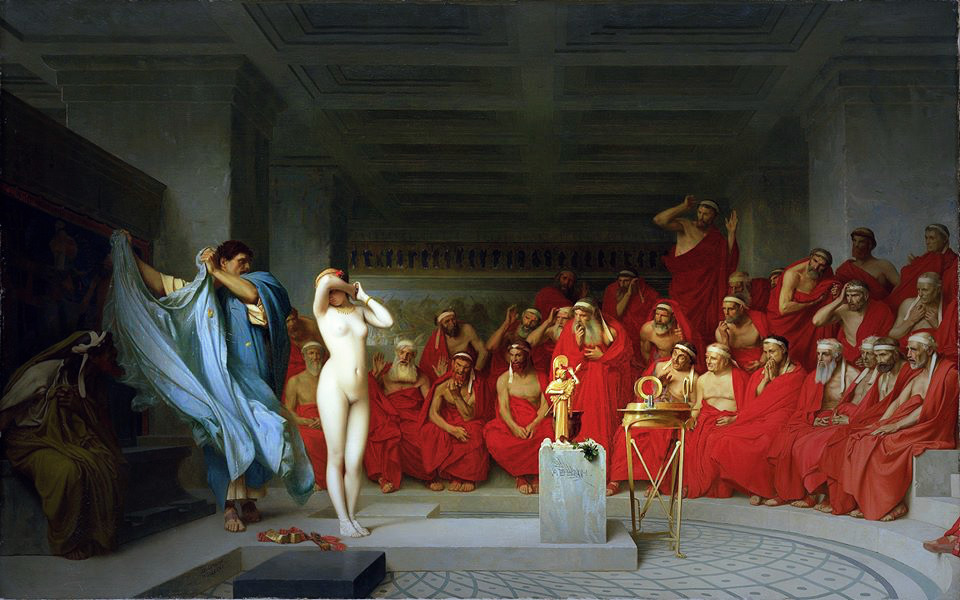
Painting by Gérôme depicting hetaira Phryne on trial. The sight of her nude body, according to legend, persuaded the jurors to acquit her.
 Princess Giulia Ricci